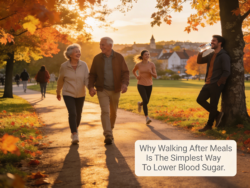
Why Walking After Meals Is The Simplest Way To Lower Blood Sugar
Let me ask you something:
What if I told you there’s a simple habit that can lower your post-meal blood sugar spikes by up to 22%—without medication, without a gym, and without breaking a sweat?
You’d probably think I’m exaggerating.
But I’m not.
It’s called post-meal walking.
And it’s one of the most effective (and underrated) tools for managing blood sugar.
Here’s why it works—and how to build the habit.
What Happens When You Eat
When you eat a meal (especially one with carbs), your blood sugar rises.
Your body releases insulin to bring it back down.
But if you’re insulin resistant (which most people with Type 2 diabetes are), your body struggles to do this efficiently.
So blood sugar stays elevated longer than it should.
And over time, that causes problems.
What Happens When You Walk After Eating
Here’s the science:
When you walk, your muscles use glucose (sugar) for energy.
So if you walk right after eating, your muscles pull some of that glucose out of your bloodstream—before it has a chance to spike.
The result?
Blood sugar doesn’t rise as high
It comes back down faster
Your body doesn’t have to work as hard
And the data backs this up:
Studies show that a 10-minute walk after meals can reduce blood sugar spikes by 15–22%.
Without medication.
Without a gym.
Without intense exercise.
Just walking.
Why Post-Meal Walking Works Better Than Morning Workouts
A lot of people think:
“I’ll just work out in the morning. That counts, right?”
And yes—morning workouts are great.
But they don’t have the same effect on post-meal blood sugar.
Here’s why:
Blood sugar spikes 30–90 minutes after eating.
If you walk in the morning but don’t walk after meals, you’re missing the spike.
But if you walk right after eating, you’re catching the spike when it happens.
Timing matters more than duration.
A 10-minute walk after dinner is more effective at lowering post-meal blood sugar than a 30-minute walk in the morning.
How Long Do You Need To Walk?
Here’s the good news:
You don’t need to walk for an hour.
10–15 minutes is enough.
That’s it.
Not 30 minutes.
Not 60 minutes.
10 minutes.
And you don’t need to walk fast.
A leisurely pace works fine.
The goal isn’t to get your heart rate up.
The goal is to move your muscles so they use glucose.
When To Walk
Ideally, walk after every meal.
But if that feels like too much, start with one meal per day.
Dinner is usually the easiest because:
You’re home
You have time
It’s consistent
So start there.
Walk 10 minutes after dinner.
Every night.
For 30 days.
Once that becomes automatic, you can add a walk after lunch or breakfast if you want.
But one meal is enough to see results.
What If You Can’t Walk Outside?
No problem.
You don’t have to walk outside.
You can:
Walk around your house
Walk up and down your stairs
Walk on a treadmill
Walk in place while watching TV
Movement counts—even if it’s indoors.
What If You Have Joint Pain or Mobility Issues?
If walking is difficult, here are alternatives that still work:
1. Chair exercises
Seated leg lifts, arm circles, marching in place while seated.
2. Gentle stretching
Stretching uses muscles—which means it uses glucose.
3. Slow, short walks
Even 5 minutes helps.
The key:
Move your body in some way after eating.
It doesn’t have to be intense.
It just has to be consistent.
Real-World Example
Tom came to me frustrated.
His post-meal blood sugar was always over 180.
No matter what he ate.
So I asked him:
“Do you walk after meals?”
“No. I usually just sit on the couch.”
“What if you walked for 10 minutes after dinner?”
“That’s it?”
“That’s it.”
So he tried it.
After 2 weeks, he checked his blood sugar 2 hours after dinner.
Before walking: 185
After walking: 142
Same meal.
Same routine.
The only difference?
10 minutes of walking.
How To Build The Habit
Here’s the framework:
Step 1: Pick one meal
Don’t try to walk after every meal.
Start with one.
Dinner is easiest for most people.
Step 2: Make it ridiculously small
Don’t commit to 30 minutes.
Commit to 10.
Or even 5.
Start so small you can’t fail.
Step 3: Do it every day for 30 days
Consistency beats intensity.
Walking 10 minutes every night is better than walking 60 minutes once a week.
Step 4: Track it
Put a checkmark on a calendar.
Or use a habit tracker app.
Don’t break the streak.
Step 5: Add more after 30 days (if you want)
Once the habit is automatic, you can:
Walk after lunch too
Extend the walk to 15 minutes
Add a morning walk
But only if you want to.
The 10-minute post-dinner walk alone will make a difference.
What Results Can You Expect?
Here’s what happens when you build this habit:
Week 1:
You’ll feel slightly better after meals (less sluggish, less bloated)
Week 2–3:
The habit becomes automatic—you don’t have to think about it anymore
Week 4:
You’ll start noticing your post-meal blood sugar readings are lower
Month 2–3:
Your A1C will start moving in the right direction
Month 6:
Walking after meals is just something you do—like brushing your teeth
The Bottom Line
You don’t need a gym membership.
You don’t need expensive equipment.
You don’t need to “exercise” for an hour every day.
You just need to walk for 10 minutes after meals.
That’s it.
Simple. Effective. Sustainable.
Your Turn
If you’re ready to start building habits that actually stick—without relying on willpower or motivation—get the book.
Get the book + audiobook for $7.95 →
— Chef Jeff